STANISLAW IGNACY WITKIEWICZ
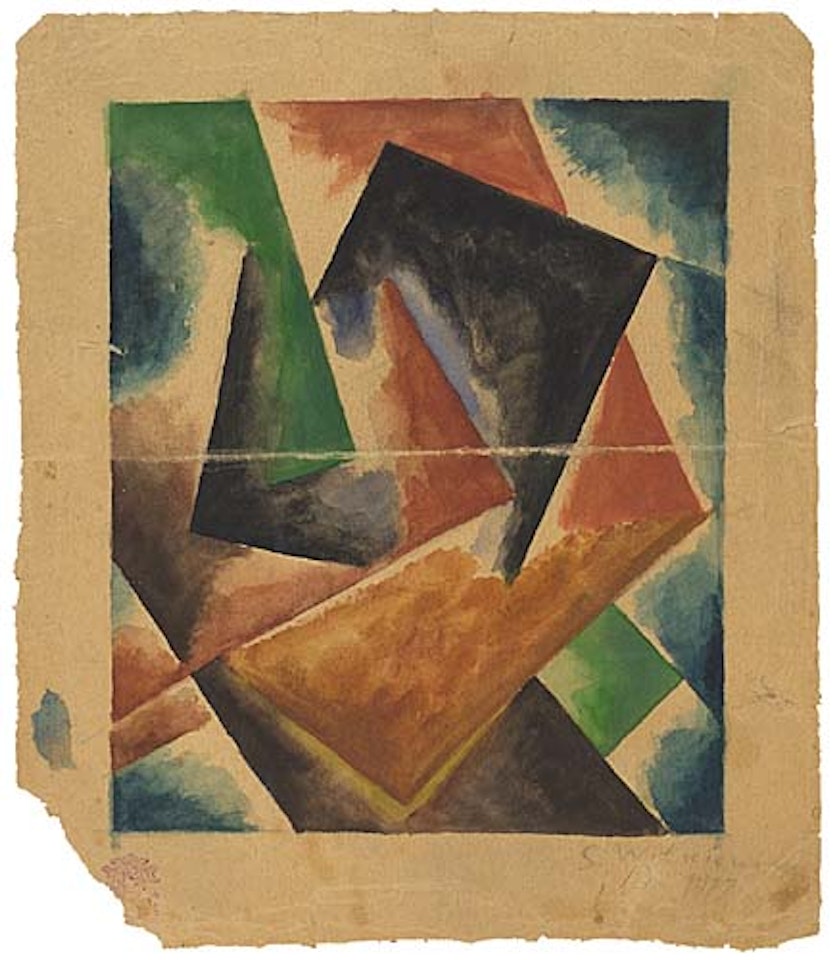
Cubist Composition >.
Watercolor on paper mounted on card stock, 1917. 202x170 mm; 8x6 3/4 inches. Signed and dated in pencil, lower right. Ex-collection unknown collector, violet ink stamp recto (not in Lugt).
Born in Warsaw, Witkiewicz (1885-1939) also known as Witkacy, was the son of an important critic, author and artist. In 1904 he enrolled at the Academy of Fine Arts in Cracow, making frequent travels to Italy, Germany and France to hone his artistic skills. Witkiewicz served as an officer in the Russian army (Warsaw was under Russian control at the time, therefore Witkiewicz was a Russian subject) during World War I and after the October Revolution (1917) was stationed in St. Petersburg, where he remained for a year. He returned to Poland in 1918 and became the main theorist of the avant-garde art movement called "Formism" (1918-22). In 1919 he published his seminal work on aesthetics, New Forms in Painting >, in which he elaborated the concept of "pure form" in art.